
Redaction appearance — final redaction style, redline transparency, exemption-code overlay and enforcement, and approval before export
Last updated: July 30, 2026 by Steve
Redaction Appearance
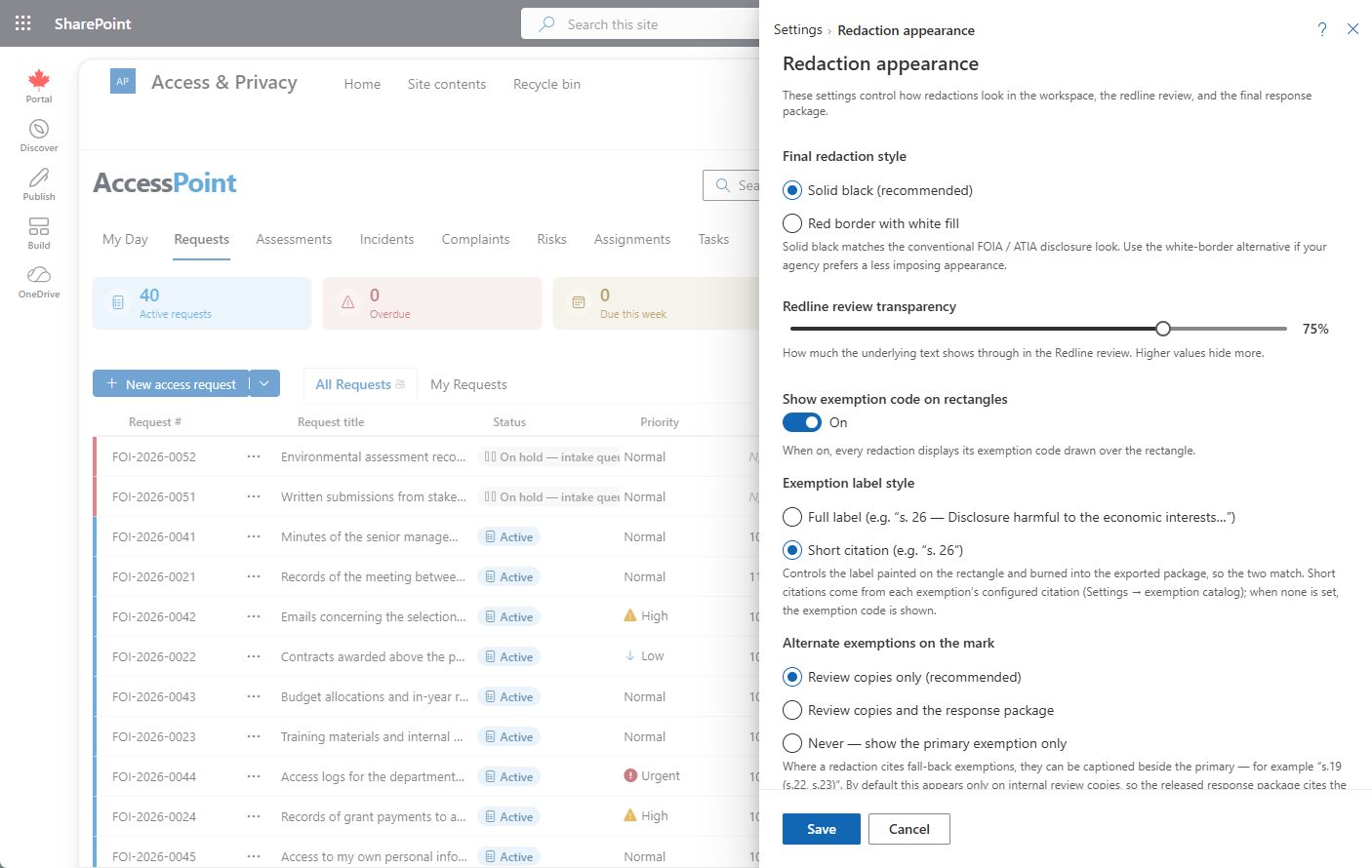
Redaction appearance controls how redactions look and behave when a response package is produced: the final style on the released copy, how see-through redactions appear on the redline review copy, whether exemption codes are printed over each box, whether untagged redactions may block an export, whether unreviewed proposed redactions warn or block at export, and whether redactions must be approved before export.
Where to find it
Open the Settings hub and choose Redaction appearance, in the Documents & review group beside Exemptions.
Options
| Option | What it controls |
|---|---|
| Final redaction style | The appearance of applied redactions on the final release — the recipient's solid, opaque view |
| Redline transparency | How redactions render on the Redline review copy, so reviewers can read what is underneath (versus the opaque final) |
| Exemption-code overlay | Whether each redaction prints its exemption code on the box |
| Exemption-code enforcement | Whether untagged redactions block a Response export (Require), only warn with a Proceed anyway option (Warn), or are allowed (Off) |
| Proposed-redaction enforcement | Whether unreviewed proposed redactions (pattern, rule, AI, and prior-request suggestions awaiting accept/dismiss) warn at Response export — with a Review suggestions shortcut — or block it, enforced server-side until every proposed mark is accepted or dismissed |
| Approval before export | Whether redactions must be approved before a package can be exported |
How it affects end-user behavior
In the redaction workspace, coordinators tag each redaction with one or more exemption codes (which cite a legal authority); redactions are colour-coded by category, and a Redacted Preview simulates the recipient's solid-black view. On export from the Documents workspace:
- The Redline review export defaults to a translated "REVIEW COPY — NOT FOR RELEASE" watermark so it cannot be mistaken for a final release.
- If enforcement is set to Require, untagged redactions block the Response export; Warn instead offers Proceed anyway.
- If approval before export is on, redactions enter Pending approval and an Approver confirms them before a package can be produced. Administrators can reopen a locked redaction for re-disclosure.
Suggested redactions — whether from your rules and detection patterns or, when AI Assist is enabled, from AI redaction analysis — are only proposals. They flow through the same review pipeline as manual redactions: a coordinator accepts or dismisses each one, and when approval before export is on they are equally subject to the mandatory approval step before a package can be produced.
Tips
- Turn on approval before export where policy requires a mandatory second set of eyes before release.
- Use Require enforcement to prevent uncited redactions from ever shipping.
- Enable the exemption-code overlay when recipients expect the cited provision printed on each redaction.
- Where a redaction cites alternate exemptions, the overlay can print the fallbacks in parentheses (e.g.
s.19 (s.22, s.23)), collapsing to a count (s.19 (+2)) when they don't fit. This defaults to redline copies only, so the released copy stays clean.