
Duplicate documents — decision-based duplicate handling with an authoritative copy, per-member decisions, and redaction propagation
Last updated: July 22, 2026 by Steve
Duplicate Documents
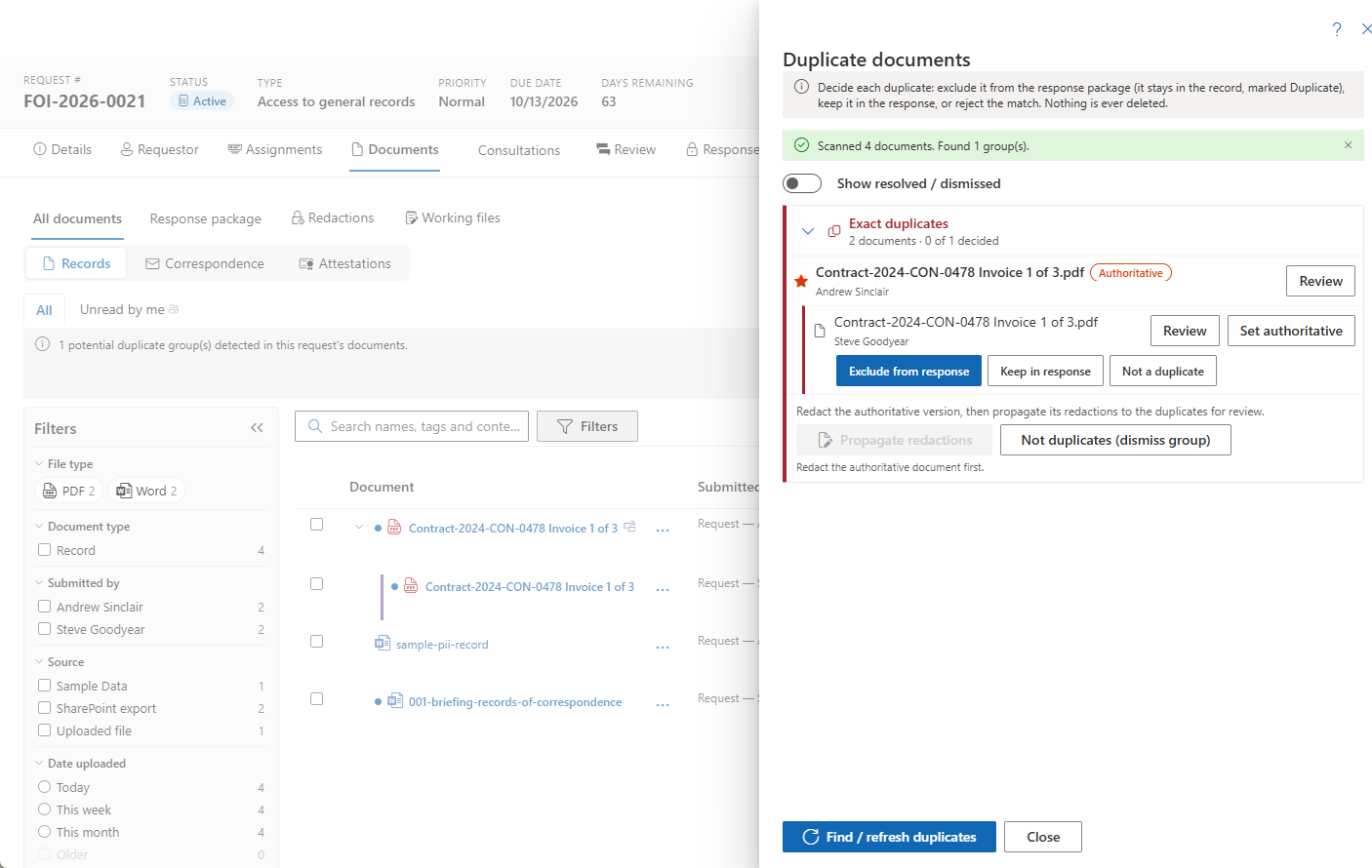
The Duplicate documents panel groups near-identical records in a request so you review them once instead of many times. Open it from the toolbar of the Documents workspace — the badge on the button shows the number of active groups.
How Duplicate Detection Works
Detection runs locally and it groups but never deletes: every document stays in the request. The effect is purely on your review workload, because you can redact one authoritative copy and propagate the result instead of redacting every copy separately. With the optional AI components deployed, an additional semantic pass also catches pairs plain text-matching can't see — a translation of the same memo, or a heavy rewrite.
Groups are colour-banded by the technique that matched them:
- Exact (red)
- Near duplicate (orange) — shown with a similarity percentage
- Email family (blue)
Finding Duplicates
- Open the request's Documents tab and open the Duplicate documents panel from the toolbar.
- Click Find / refresh duplicates to scan.
- Expand a group to see its members.
Handling a Group: Decision-Based Review
Handling a group is decision-based — you record an explicit decision per member, and the group's status derives from those decisions:
- Mark the best copy as authoritative (Set authoritative) — the one the office will process. Use Review on any member to open it in the preview/redaction viewer.
- For each duplicate copy, choose Exclude from response (it stays on the request but drops out of the release), Keep in response, or Not a duplicate (a false match). Every decision shows who made it and can be reversed with Undo.
Propagating Redactions
- Redact the authoritative document.
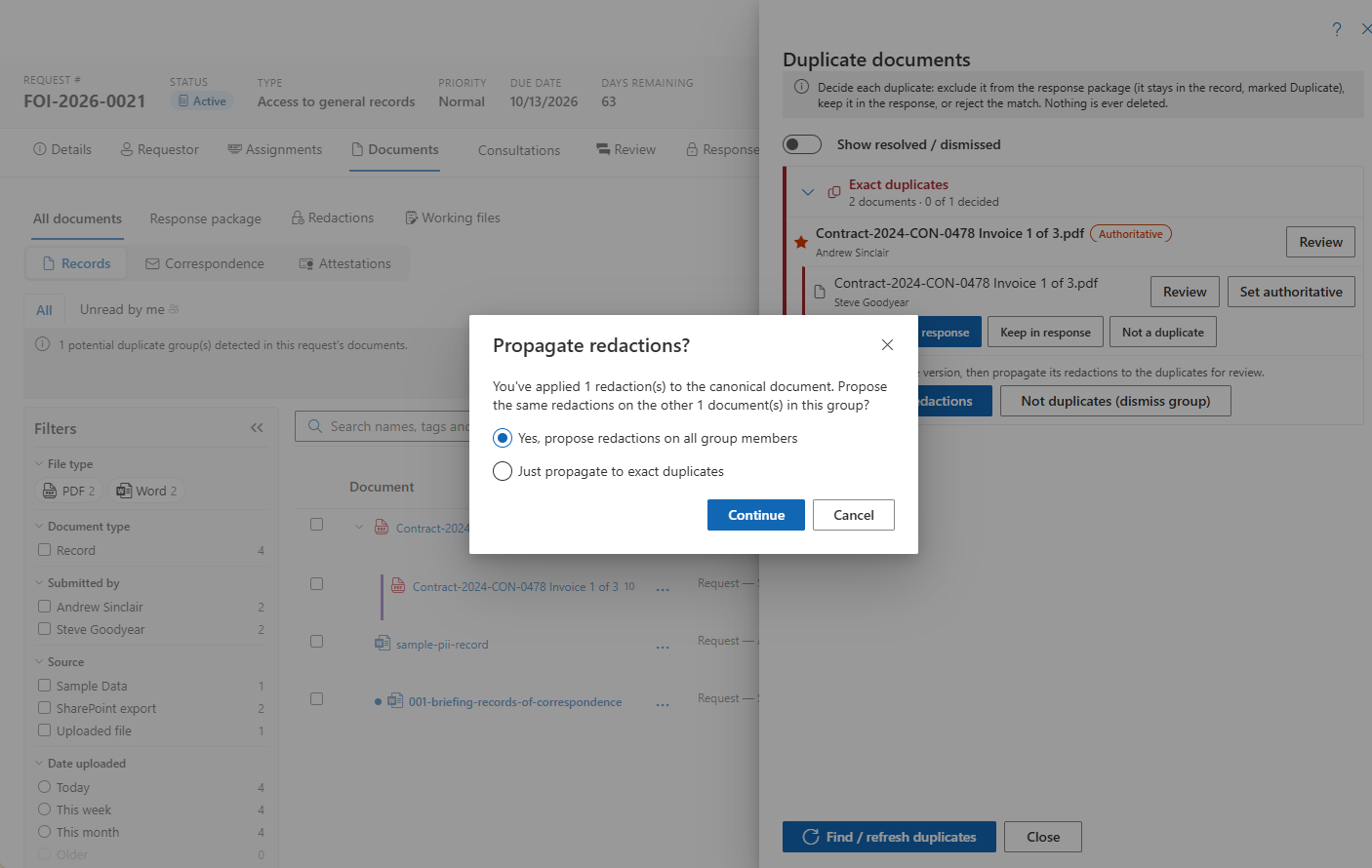
- Click Propagate redactions to push its redactions to the members you are keeping.
- Each copy shows the proposed redactions for you to Confirm or Discard per member.
Resolved and Dismissed Groups
- A group's Resolved status is derived from its members' decisions — once every duplicate has a decision, the group drops out of the default list.
- If a whole group is a false positive, use Not duplicates (dismiss group).
- Use the Show resolved / dismissed toggle to revisit groups you have already dealt with.